



For them, it is not only a passion, a deep connection, and a tribute to the cultural beauty of their people, but it also contributes to creating a livelihood and stabilizing their families’ lives.
Traditional clothing is an important part of the cultural heritage of every ethnic group. Every stitch, pattern, and design reflects a unique identity, showcasing the daily life, aesthetic concepts, and cultural characteristics of the community. To create these outfits, the role of women is particularly crucial. Transitioning from sewing clothes for daily wear and festivals, many women have boldly brought their traditional products to the market, gradually turning tailoring into a stable source of income.
.jpg)
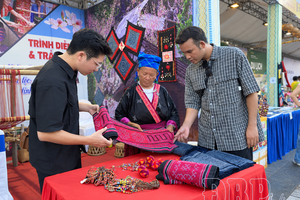
With nearly 20 years of dedication to tailoring, selling, and renting traditional Thai ethnic clothing, Lò Thị Phung from Pá Đông village, Mường Thanh ward, still holds a special love for the traditional “cóm” shirt. Phung recounted that since childhood, she loved wearing the “cóm” shirt and admiring the rows of butterfly buttons meticulously attached to the bodice of Thai women’s shirts. That love urged her to learn tailoring and eventually open her own shop.
Phung’s customers are quite diverse, ranging from local residents and people from neighboring communes to visitors from other provinces. In addition to making and selling traditional dresses and shirts, she also sells jewelry and accessories such as bracelets, necklaces, butterfly buttons, and silver chains, helping customers easily choose a complete outfit. Depending on the material and design, each set of “cóm” clothing is priced between VND 400,000 and VND 800,000. Specifically, for shirts made of traditional indigo-dyed cotton of the Thai ethnic people, women’s shirts cost from VND 450,000 to VND 500,000 each, while men’s shirts range from VND 500,000 to VND 700,000 each.
There was a time when the craft of sewing traditional clothing brought a fairly high income to her family. About five years ago, the number of customers was large, and her downstairs shop was always as bustling as a miniature garment factory. She had to hire additional tailors, while she handled the cutting and quality-checking of products before delivering them to customers. At times, performance art teams ordered dozens of outfits at once with tight deadlines, forcing her to hire more workers for overtime. The process of attaching butterfly buttons alone took a lot of time, requiring extra helpers. Thanks to this, in some months, her family’s income reached about VND 30,000,000.
.jpg)
Like Phung, Lò Thị Hiếng in Phủ village, Thanh An commune, has been dedicated to the craft of sewing Thai ethnic clothing for over 10 years. Her stall is located near the Hoàng Công Chất Temple area, attracting quite a large number of customers and becoming a familiar address for young people in the areas of Sam Mứn, Thanh An, and Thanh Yên communes.
Faced with socio-economic development and the strong influx of modern fashion, traditional clothing is gradually facing the risk of fading away. In recent years, the growth of online shopping has significantly reduced the number of customers coming to tailor shops in person. The number of customers ordering strictly traditional designs has decreased, with most opting for modernized styles.
Lò Thị Hiếng shared that customer preferences are now very diverse. Most middle-aged female customers still prefer ethnic clothing made from traditional fabrics or solid colors, choosing the signature V-neck and high-collar traditional designs of Thai women. Customers between 35 and 45 years old prefer “cóm” shirts made of patterned fabrics or mixed with brocade motifs. Meanwhile, young people tend to choose modernized clothing with many changes to the collar, three-quarter or short sleeves, or added decorative details to create a novelty effect.
To maintain the beauty of their ethnic clothing, Phung and Hiếng always encourage and advise customers to choose traditional designs and limit modern alterations. According to them, preserving traditional features not only helps protect the ethnic cultural identity but also retains the unique beauty of Thai clothing across many generations.
.jpg)
Adapting to new trends, Phung and Hiếng have also proactively changed their business methods, reaching customers through social media platforms and selling online to expand their markets. This both generates additional income and promotes the beauty of their traditional ethnic clothing. For instance, Phung actively participates in festivals and fairs within and outside the province to promote her products. From learning how to sell online, she has now set up three Facebook pages, including Áo cóm Điện Biên, Áo cóm dân tộc Thái, and Phung Kim, to introduce her products. As a result, many customers in distant provinces such as Hồ Chí Minh City, Đắk Lắk, and Nghệ An have learned about her business and placed orders. Hiếng also advertises and sells through TikTok, Facebook, and Zalo.
Amidst modern life, the image of women still working diligently at their sewing machines, carefully making every cut and meticulously attaching rows of butterfly buttons to create traditional outfits, is not merely preserving a profession but also contributing to keeping the soul of the ethnic culture alive. Every “cóm” shirt, every row of butterfly buttons, or hand-embroidered motif is not just a garment but a vessel carrying cultural beauty, customs, and pride.
Bình Nguyên
.jpg)
.jpg)
.jpg)
.jpg)

.jpg)
.jpg)
.jpg)


.jpg)
.jpg)
.jpg)
You have 500/500 characters left
Please enter 5 or more characters!!!